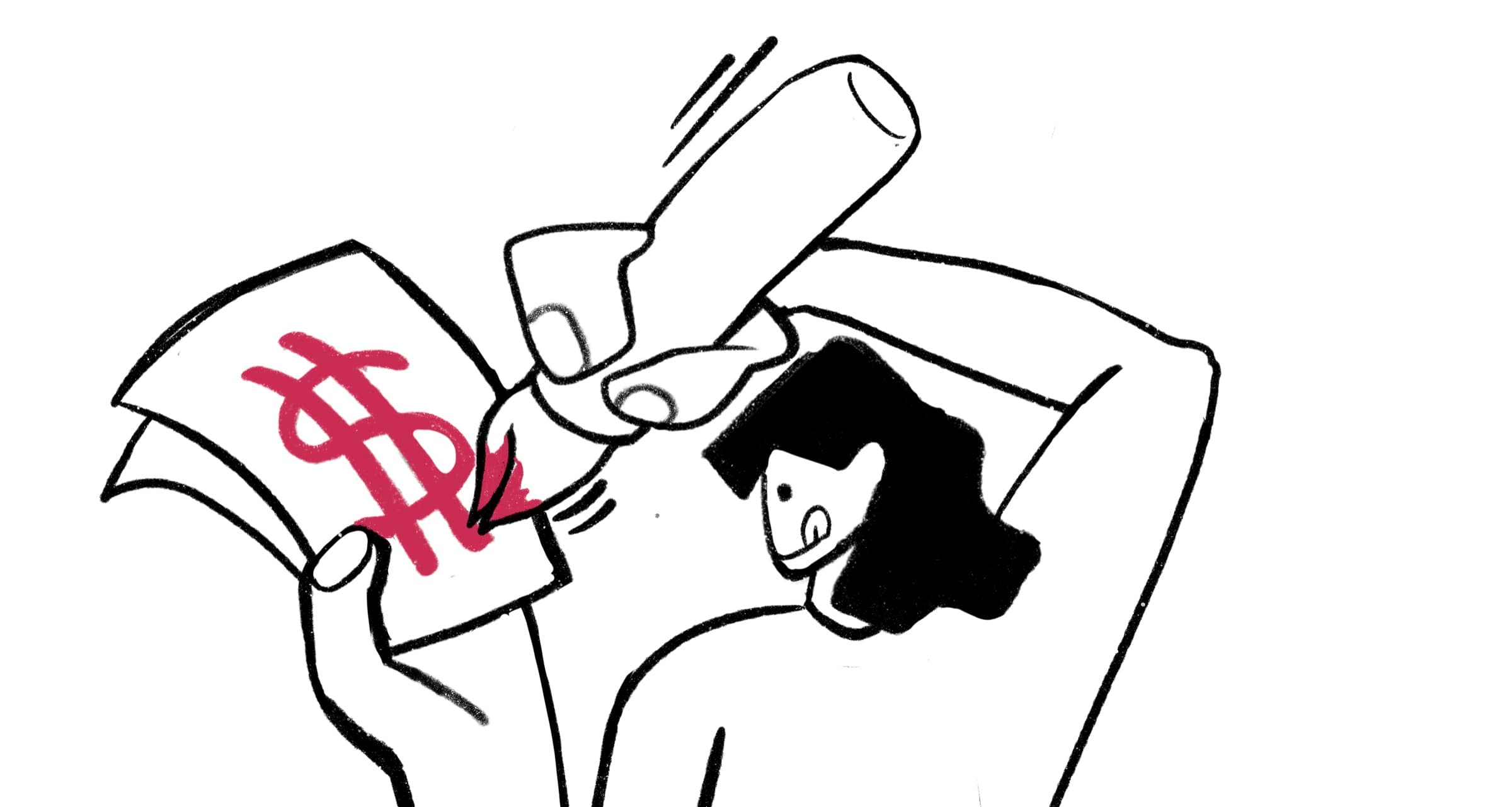
If you ask ten artists how they make money, you'll get ten different answers, and most of them will be partially true at the same time. A single working artist might get a paycheck from a part-time job, an invoice from a freelance client, a grant deposit, and a check from a gallery sale, all in the same year. There's no one job title, no one paycheck.
That's confusing when you're starting out, because almost none of us are taught how any of this actually works. So here's the real breakdown, not the inspirational version but the mechanical one: where artist income actually comes from, how each type of money moves, and what to know before you're relying on it.
The Two Buckets: Earned Income vs. Awarded Money
Almost every dollar an artist makes falls into one of two categories, and they work completely differently.
Earned income: someone pays you for a service or a deliverable. A job, a freelance gig, a commission, a sale. You're paid because you did something for someone, on terms you (at least partially) negotiated.
Awarded money: a grant, a fellowship, a prize. Nobody is buying a deliverable from you. An organization is investing in you or your project because it aligns with their mission, and they need to be able to report that investment as impact to their board or funders. It's not free money. It's an exchange, just a different kind than a paycheck.
Most artists need both. Relying on only one is usually a fragile place to be.
Earned Income: The Four Ways You Get Paid for Work
1. Full-time or part-time employment
Straightforward: W-2, regular paycheck, possibly benefits. Least flexible, most stable. Common in animation studios, design agencies, production companies, museums.
2. Freelance gigs
This is where most independent artists actually live day to day, and it has its own real financial logic that's worth understanding before you take a single gig:
- Pricing models: hourly, flat project fee, day rate, value-based, or retainer. Each fits a different kind of work: hourly for undefined scope, flat fee for clear deliverables, day rate for on-set or production work.
- The rate math that actually holds up: take your target annual income, divide by billable hours, not total working hours. Roughly 60% of a freelancer's time is billable; the rest is admin, marketing, and finding the next gig. A $75,000 target over 1,200 billable hours (2,000 hours/year × 60%) works out to about $62.50/hour as a floor, before taxes.
- Payment terms that protect you: 25 to 50% deposit upfront, milestone payments on larger projects, final payment due before final files go out. Net-15 or Net-30 for established clients; avoid Net-60+.
- The tax reality: self-employment tax is 15.3% on top of regular income tax. Set aside 25 to 35% of every freelance payment. Clients issue 1099s for anything over $600.
Genuinely useful sources here: Bandzoogle's 18 Ways Musicians Can Make Money, Wrapbook's Ultimate Guide to Day Rates, and the Graphic Artists Guild Handbook, which is the industry-standard reference for freelance design and illustration rates.
3. Commissions and sales
Someone (a collector, a business, a city) is paying for a specific piece or body of work. Pricing here is its own skill. Contemporary Art Issue's How to Price Your Art and ArtConnect's pricing guide both break down the actual frameworks working artists use, rather than guessing a number that feels right.
For larger public commissions, there's usually a formal, multi-stage process: RFQ to shortlist to RFP (sometimes paid at this stage) to finalist to commission. Budgets on this scale need to account for far more than the piece itself: fabrication, insurance, engineering, installation, and maintenance all come out of the same number.
4. Licensing and royalties
Less visible, still real: sync licensing (your music placed in a show, ad, or film), residuals, performance royalties through a PRO (performing rights organization). This income is often smaller per-instance but recurring, money that keeps arriving from work you already made.
Awarded Money: Grants, Fellowships, and Residencies
This is the bucket that confuses people most, because it doesn't behave like a paycheck at all.
Grants fund a specific project or, less commonly, general operating support. The money isn't free. It comes with reporting obligations, and there's often a full application cycle (usually opening around January or July, tied to funders' fiscal years) before you ever see a check. Budgets should always include your artist fee, never price yourself at zero, plus a standard contingency (commonly around 15%) and tax set-aside if you're independent.
Worth knowing before you apply anywhere: less than 10% of NEA applications get funded, and at large private funders like Ford Foundation, less than 1% of unsolicited applications succeed. That's why program officer relationships and multiple application cycles matter so much more than most people expect. Almost nobody gets funded on their first try. That's normal, not a sign you're doing it wrong.
Fellowships pay you for trajectory and potential more than for a single deliverable. Think of them as recognizing where your career is headed, not just funding one project. The money matters, but the network and validation that come with it are often worth more long-term (a fellowship from one program is frequently a stepping stone to the next one).
Residencies give you time and space rather than a check. They range from fully-funded to pay-to-stay, and even "fully funded" rarely means fully compensated. Lost income, travel, and health insurance gaps during your stay are real costs that don't show up in the program's marketing.
The Financial Habits That Actually Matter
Regardless of which bucket the money is coming from, a few things hold true across almost every artist's income:
- Never price at zero. Whether it's a freelance quote or a grant budget, your fee belongs in the number.
- Track everything. Every invoice, every contract, every 1099, every receipt. Irregular income is much easier to manage with a paper trail than without one.
- Diversify on purpose. A single income stream, one client, one grant, one platform, is the most common way artist income collapses. Most sustainable careers blend at least two of the categories above.
- Know your deductions. Home studio space, supplies, business travel, even health insurance premiums can be deductible for artists working as a business, not a hobby. Worth an actual read of a resource like Nolo's Tax Deductions for Artists rather than guessing.
The Bottom Line
There's no single answer to "how do artists get paid" because there's no single artist career. The ones who build something sustainable tend to understand which bucket each dollar is coming from, what that bucket actually expects of them in return, and how to price and protect their own time inside it.
That's exactly the kind of knowledge DEZI's Learning Path is built to walk you through role by role, not generic advice, but the actual financial mechanics behind the work you do.
Sources referenced: Bandzoogle, Wrapbook, Contemporary Art Issue, ArtConnect Magazine, Graphic Artists Guild Handbook, Nolo Legal Encyclopedia, Greg Mason Burns (grant reviewer perspective), and DEZI's internal Knowledge Framework (Topic 3: How Money Works; Layer 2 Topics B & C: Funding Ecosystem and Financial Logic).